Why are my orchid leaves turning yellow?
Short answer
First, look at which leaf is yellow. The oldest leaves are the lowest ones, nearest the pot. If just one of those bottom leaves is turning yellow and the rest of the plant looks healthy, that’s normal: the orchid is shedding an old leaf. If newer leaves higher up are yellowing or shriveling, something is wrong, most often roots rotted by overwatering or old, broken-down bark. Too little water and too much light are the other common causes.
Quick check: what do you see?
Start with the row that matches your plant best, then jump to that cause for how to confirm it and fix it.
| What you see | Most likely cause |
|---|---|
| Just one of the lowest leaves (nearest the pot) yellowing; the rest firm and green | Normal shedding of old leaves |
| Newer leaves yellowing and shriveling; mix wet or bark broken down like mulch | Root rot from overwatering or old bark Most common |
| Leaves wrinkled and limp; pot light; roots above the pot dull silver | Too little water or humidity |
| Leaves yellow-green or almost yellow, with pink or reddish edges | Too much light |
Compare the symptoms
Illustrations, not photos: drawn to show the typical pattern of each cause. Free to reuse.
- Normal shedding of old leaves
- Root rot from overwatering or old bark
- Too little water or humidity
- Too much light
The 4 causes, and how to fix each
1. Normal shedding of old leaves
CommonSigns
- Only the oldest leaf, the lowest one nearest the pot, yellows and shrivels.
- The newer leaves above it stay firm and green.
How to confirm
- Check the roots: healthy orchid roots are white with green tips.
How to fix it
- No treatment needed. Once the old leaf has yellowed, cut it off at the base of the plant.
Based on: University of Maryland Extension [1], Clemson Cooperative Extension [4], University of Maryland Extension [2]
2. Root rot from overwatering or old bark
Most commonSigns
- Newer leaves, not just the oldest, turn yellow and shrivel: a sign of distress.
- Leaves shrivel even though the pot is wet, because rotted roots can’t take up water.
- The bark has broken down into fine, mulch-like bits that drain poorly and hold too much water.
How to confirm
- Take the plant out of its pot and look at the roots. Healthy roots are white with green tips; dead roots decompose and hold moisture.
- Fine bits of bark washing out when you water mean the mix is breaking down.
How to fix it
- Trim off dead, discolored or damaged roots with sterile snips, removing only the dead material.
- Repot in fresh orchid bark mix, in a pot just big enough for the roots.
- Water only in the morning, so the plant dries out by nightfall, and never let it stand in water.
- If you use a pebble tray for humidity, don’t flood it: wet roots rot.
Based on: University of Maryland Extension [1], University of Maryland Extension [2], Clemson Cooperative Extension [4]
3. Too little water or humidity
CommonSigns
- Leaves wrinkle and shrivel because too little water reaches them.
- Low humidity combined with too little water causes wrinkled leaves.
How to confirm
- Lift the pot: if it feels light, it needs water.
- Roots above the pot stay dull silver or white; they turn pale green once they’ve had enough water.
How to fix it
- Water at the sink with lukewarm water, running it through the pot for a minute or so, or in 3–4 drenches over about 10 minutes.
- Let it drain completely before it goes back on its saucer.
- In bark, water about once a week; misting alone doesn’t give it enough moisture.
- Set the pot on a pebble tray to raise the humidity around it (without flooding the tray).
Based on: University of Maryland Extension [1], University of Maryland Extension [2], Clemson Cooperative Extension [3]
4. Too much light
Less commonSigns
- Leaves look yellow-green or almost yellow.
- Pink or reddish color develops along the leaf edges.
How to confirm
- Leaves on a well-lit orchid are light green; yellow-green leaves with reddish edges mean too much light.
How to fix it
- Move it out of direct sun into bright, indirect light, ideally an east-facing window.
- If it spends summer outdoors, keep it in shade so the sun doesn’t burn the leaves.
Based on: University of Maryland Extension [2], Clemson Cooperative Extension [3]
Look-alikes: what it might not be
Dark green, stiff leaves mean too little light
The opposite of yellowing: leaves that turn dark green and feel very stiff are a sign of low light, which is also the most common reason an orchid won’t rebloom. [2]
Rot at the center of the plant
Bacterial rot can start when water sits in the center shoot or around the leaf bases. Water in the morning so the plant dries by nightfall. [1]
Roots growing out of the pot are normal
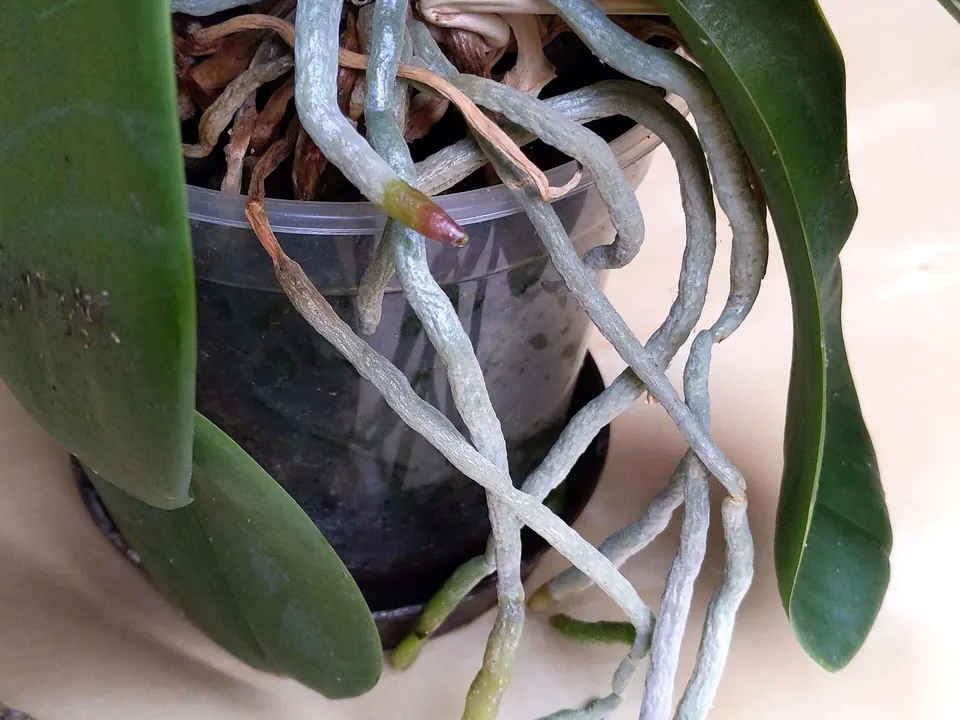
Many moth orchid roots grow above the pot. That’s normal, so don’t cut them off. [2]

How to prevent it
- Water about once a week in bark, in the morning, and let the pot drain completely.
- Replace the bark every one to two years, before it breaks down.
- Use a pot just big enough for the roots, and never let it stand in water.
- Give it bright, indirect light, ideally from an east window.
- Use a pebble tray for humidity rather than relying on misting.
Questions people ask
Is it normal for orchid leaves to turn yellow?
For the oldest, bottom leaf, yes: moth orchids shed old leaves. Yellowing and shriveling of newer leaves is a sign of distress, so check the roots. [1]
Should I cut off yellow orchid leaves?
Once an old leaf has yellowed, you can cut it off at the base of the plant. [2]
Why are my orchid leaves yellow and wrinkled?
Too little water is reaching them. That can mean underwatering and low humidity, or roots that have rotted and can’t take up water, so check the roots before watering more. [1, 2]
Will a yellow orchid leaf turn green again?
Don’t count on it. If the cause isn’t fixed, yellow leaves go on to turn brown, so fix the cause to keep new leaves healthy. [5]
Sources
Facts on this page were checked against these sources on November 6, 2026. The wording and illustrations are our own.
- Q&A: What causes orchid leaves to turn yellow and shrivel?. University of Maryland Extension, Maryland Grows. Dec 26, 2018.
- Care of Phalaenopsis Orchids (Moth Orchids). University of Maryland Extension. Updated Mar 13, 2023.
- General Care for Phalaenopsis Orchids. Clemson Cooperative Extension, Home & Garden Information Center. Feb 13, 2020.
- Repotting Your Orchid. Clemson Cooperative Extension, Home & Garden Information Center. Mar 9, 2023.
- Yellowing Leaves on Indoor Plants. University of Maryland Extension. Updated Mar 13, 2023.
Spotted a mistake? Report an error and we'll check it against the sources and update the page.