Jade plant care: sun, watering and keeping it compact
Short answer
Jade plants do best with four or more hours of direct sun a day but cope with bright, indirect light. Let the soil dry (or nearly dry) between deep waterings, and water much less in winter. Use a fast-draining cactus or succulent mix and a heavy pot as the plant grows, and feed lightly while it’s growing. It’s toxic to cats, dogs and horses.[1, 2, 3, 4]
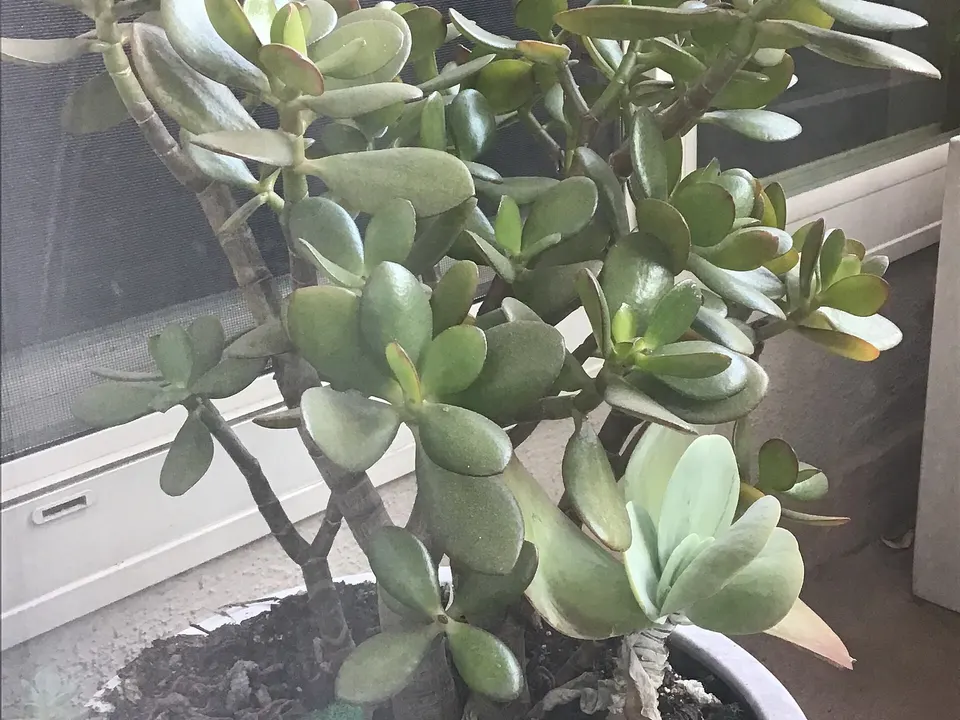
Jade plant care at a glance
| Light | 4+ hours of direct sun; bright light at least |
|---|---|
| Watering | Deeply, once the soil is (nearly) dry; little in winter |
| Soil and pots | Fast-draining cactus mix; a heavy pot |
| Temperature | 65–75 °F days, 50–55 °F nights |
| Feeding | Lightly, while it’s growing |
| Repotting | Every 2–3 years, as new growth starts |
| Pruning | In spring, back to a side branch |
| Propagation | Stem or leaf cuttings, dried first |
| Flowers and size | Star-shaped winter flowers; up to 5 feet |
| Pets | Yes: toxic to cats, dogs and horses |
Light
- It does best with four or more hours of direct sun a day, such as a south window, but copes with bright, indirect light. [1, 2, 3]
- With too little light the leaves turn deep green and the stems droop; in good light the leaves are edged with red. [1]
- Move it outdoors gradually, or the leaves can sunburn. [1]
Watering
- Guides differ for spring and summer: Wisconsin and Illinois say let the soil dry (or nearly dry) between deep waterings; Clemson says keep it moist but never wet. [1, 2, 3]
- In winter, when it’s semi-dormant, water much less and let the soil dry between waterings. [1, 2]
- Overwatering makes leaves drop and the stem rot; extreme dryness causes stunting, spotted leaves and leaf drop. [1, 2]
Soil and pots
- Use a well-drained, porous mix made for cactus or succulents; extra perlite or sharp sand helps. [1, 2]
- Clemson’s homemade mix: three parts coarse sand, one part sterilized organic soil and one part sphagnum peat moss. [2]
- Once it gets top-heavy, move it to a large, heavy pot so it doesn’t tip over. [2]
Temperature
- It likes 65–75 °F by day and 50–55 °F at night, but tolerates a wide range. [1, 2, 3]
- Keep it out of drafts, and don’t let the leaves touch cold windowpanes. [2]
- It may survive a light frost but freezing kills it, so bring it indoors before the first frost. [1]
Feeding
- Feed lightly while it’s growing. Guides differ on how often: Wisconsin suggests every two months (or a dilute feed more often); Clemson every three to four months with a liquid houseplant fertilizer. [1, 2]
- Wait four months before feeding a freshly repotted plant. [2]
Repotting
- Repot every two to three years, or when it gets top-heavy, ideally as new growth starts. [1, 2]
- It can live happily root-bound for years. [1, 2]
- After repotting, water sparingly and let the soil dry until it settles in. [1, 2]
Pruning
- Prune in spring, cutting stems back to a side branch, to keep it compact and vigorous. [1]
- The cuts heal over in a few days, and new growth appears within a few weeks. [1]
Propagation
- It roots easily from stem or leaf cuttings, most easily in summer. [1, 2]
- Let cuttings dry for a few days so the cut heals over, then set them in fairly dry, well-drained mix. [1]
- Roots form in a few weeks. [1]
Flowers and size
- Mature plants can bear clusters of star-shaped white or pink flowers in winter. [2]
- To encourage flowers, water less in fall and keep it cool (around 55 °F), especially at night, with no extra light in the evenings, for several weeks. [1]
- It grows slowly, lives for many years, and can reach 5 feet tall indoors. [1, 2, 3]
Is jade plant toxic to pets?
- The ASPCA lists jade (under its older name, Crassula argentea) as toxic to dogs, cats and horses. [1, 4]
- Signs include vomiting, depression and loss of coordination. [4]
Compare with other plants in our pet-safe houseplant checker.
Jade plant varieties
| Variety | What it looks like |
|---|---|
| 'Hobbit' | Tubular, pipe-shaped leaves with reddish tips and dense foliage; up to 3 feet. [1, 2] |
| 'Gollum' | Nearly tubular leaves with a reddish tint. [1] |
| 'Sunset' (golden jade) | Leaves edged in gold in bright light. [2] |
| 'Tricolor' | Pointed leaves striped creamy white and rose; pink and white flowers. [1, 2] |
| 'California Red Tip' | Leaves edged purplish-red in bright light to full sun. [1, 2] |
| 'Bronze Beauty' (copper jade) | Small coppery green leaves on very slow-growing stems. [1, 2] |
| Silver jade (Crassula arborescens) | Blue-gray leaves with red edges. [2] |
Common jade plant problems
| What you see | Usual cause |
|---|---|
| Leaves dropping | Overwatering, or the soil getting extremely dry; also sunburn or frost damage. [1, 2] |
| Deep green leaves, drooping stems | Too little light. [1] |
| Root rot | A mix that drains slowly, or watering too often. [2] |
| White cottony bugs (mealybugs) | The most common pest. Wipe them off with a cotton swab dipped in rubbing alcohol; avoid insecticidal soap, which can damage the leaves. [1, 2] |
| Dull, speckled leaves | Spider mites. [2] |
Not sure what's wrong? Use the plant doctor to match what you see to a cause.
Questions people ask
How often should I water a jade plant?
Water deeply, then wait until the soil is dry or nearly dry before watering again. In winter, water much less. [1, 3]
Is jade plant toxic to cats and dogs?
Yes. The ASPCA lists it as toxic to dogs, cats and horses; signs include vomiting, depression and loss of coordination. [4]
Why is my jade plant dropping leaves?
Usually overwatering, or the soil getting extremely dry. Sunburn and frost can also make leaves fall. [1, 2]
When should I repot a jade plant?
Every two to three years, or when it becomes top-heavy, as new growth starts. Use a heavy pot and a fast-draining mix. [1, 2]
How do I get my jade plant to flower?
In fall, water less and keep it cool (about 55 °F) with no extra light at night for several weeks; then water normally again. [1]
Sources
Facts on this page were checked against these sources on November 6, 2026. The wording is our own.
- Jade Plant, Crassula ovata. University of Wisconsin–Madison Division of Extension, Wisconsin Horticulture. Revised Apr 2025.
- Jade Plant (HGIC 1507). Clemson Cooperative Extension, Home & Garden Information Center. Revised Oct 16, 2015.
- Jade Plant. University of Illinois Extension, Houseplants.
- Toxic and Non-Toxic Plants: Jade Plant. ASPCA Animal Poison Control Center.
Spotted a mistake? Report an error and we'll check it against the sources and update the page.